Nutritional Profile Comparison
Calorie and macronutrient breakdown per serving
A 30 gram handful of goji berries carries only 98 calories, while the same serving of raisins packs 90. This small difference hides a larger story about how each food fuels your body.
The macronutrient breakdown per 30g serving reveals distinct profiles:
– Goji berries: 3g protein, 21g carbohydrates, 4g fiber
– Raisins: 1g protein, 24g carbohydrates, 1.6g fiber
Goji berries offer four times the protein and nearly three times the fiber of raisins. The higher protein content makes goji berries more satiating, meaning you feel fuller for longer after eating them. Raisins, with their concentrated sugars, provide a rapid burst of energy that fades quickly.
Fiber changes how your body processes the carbohydrates in each fruit. The roughage in goji berries slows digestion considerably. I have found that raisins digest quickly and leave me hunting for another snack. Goji berries, with their chewy texture, create a more sustained feeling of fullness. When you ask are goji berries like raisins, the numbers say no, they are nutritional cousins with very different effects on your appetite.
Vitamin and mineral content: key differences
Goji berries carry a vitamin profile that raisins cannot match. A single serving delivers significant vitamin C, while raisins offer only trace amounts. Zeaxanthin appears in goji berries as well, a compound linked to eye health. Are goji berries like raisins? The mineral evidence says no!
Raisins do provide potassium and iron, which support blood pressure and oxygen transport. Goji berries counter with selenium and zinc, nutrients often missing from dried fruit. My preferred comparison for clients:
- Goji berries: vitamin C, zeaxanthin, selenium
- Raisins: potassium, iron, boron
The zinc content stands out, as it aids immune responses and tissue repair. Goji berries also contain more copper, which helps form red blood cells.
Antioxidant capacity and ORAC score comparison
Superficially, yes, but their antioxidant profiles part ways entirely. The ORAC score, a measure of antioxidant power, tells a dramatic story. Goji berries score significantly higher, while raisins, though respectable, fall behind. This difference stems from the specific compounds each fruit contains:
- Goji berries: zeaxanthin, polysaccharides, and lycopene for cellular defense.
- Raisins: resveratrol and flavonoids with a narrower protective range.
The polysaccharides in goji berries work as a unique shield against oxidative stress. This is the heart of the matter. So are goji berries like raisins? In terms of antioxidant capacity, the answer is a resonant no.
Natural sugar content and glycemic index impact
Goji berries and raisins diverge sharply once you measure sugar. A handful of raisins packs roughly 20 grams of natural sugar, while the same weight of goji berries barely reaches 13 grams. This difference matters because raisins rank higher on the glycemic index, spiking blood glucose with little ceremony. Goji berries, by contrast, release their sugars more slowly, which spares you that midafternoon crash.
So are goji berries like raisins? For anyone watching glucose levels, no. The modest sweetness of goji berries comes with fibre and polysaccharides that temper absorption. Raisins offer concentrated energy, but their sugar arrives in a rush.
Taste, Texture, and Visual Appearance
Flavor profile: sweet, tart, and earthy tasting notes
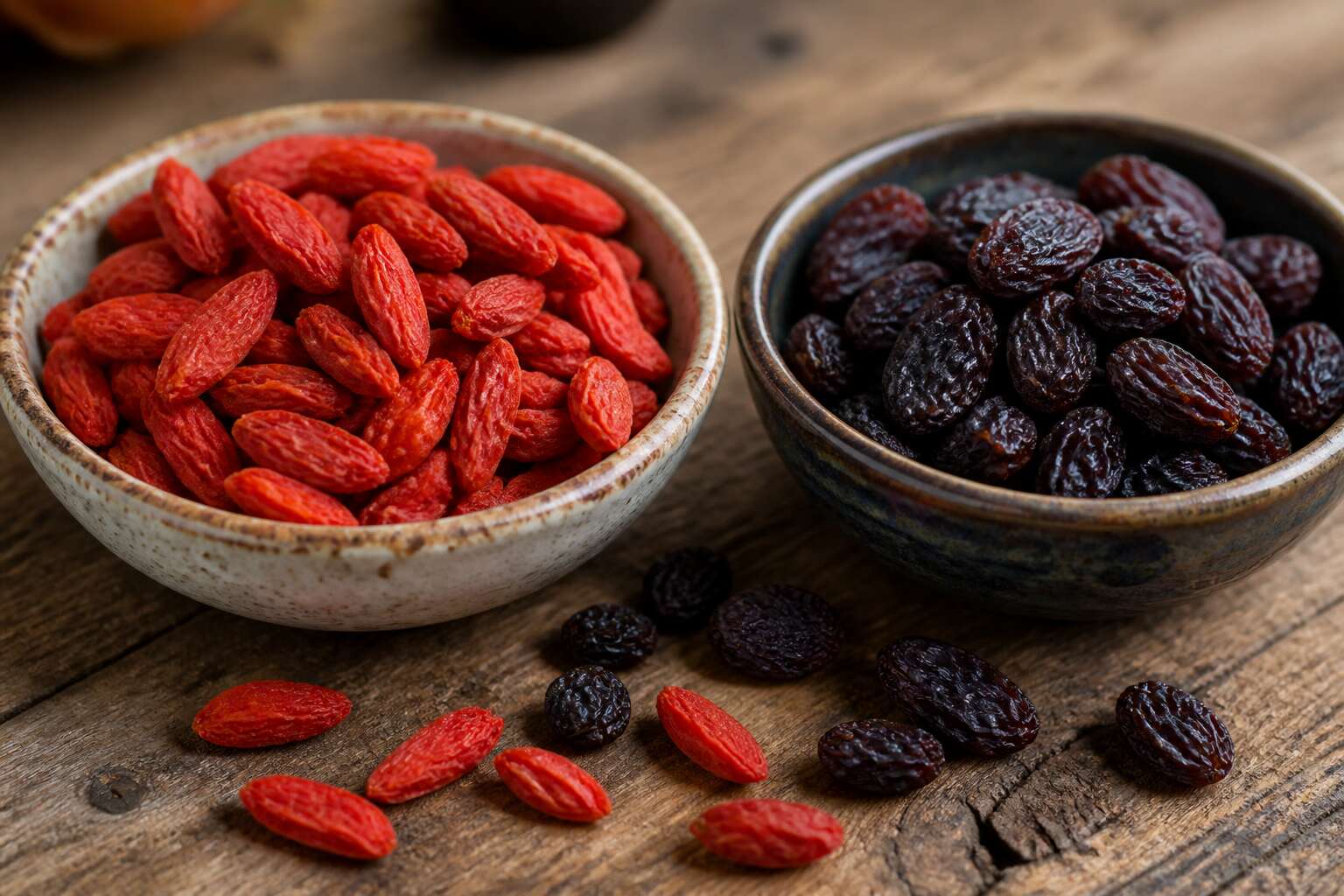
Goji berries, deep crimson and wrinkled, prompt the question: are goji berries like raisins? The initial bite reveals a texture more delicate than the raisin’s dense chew. Taste differs. Where a raisin offers simple grape sweetness, a goji berry unravels in layers. First comes a fruity sweetness, then a sharp, playful tartness, and finally a lingering earthy note reminiscent of dried thyme. This savoury undertone completes the profile, adding a complexity that defies comparison.
The dark, shrivelled appearance of a raisin is a stark contrast. Their texture is crisp at the surface, giving way to a soft, creamy interior. Raisins are uniform; goji berries are individualistic, each batch offering a different balance of sweet and tart. So when you ask are goji berries like raisins, the honest answer is that they share a chewy familiarity, but their flavour profile is distinct, wilder and more intriguing.
Texture comparison: chewiness, softness, and mouthfeel
Goji berries and raisins both arrive shrivelled, but their visual kinship stops there. A raisin is uniformly dark, nearly black in places, with a sticky sheen. Goji berries hold a reddish orange colour that catches the light. Up close, raisins look like deflated grapes, while goji berries resemble tiny crimson pods.
Touch tells the deeper story. Raisins offer a dense, tacky chew that clings to the teeth. Goji berries are lighter, almost spongy, with a slight pop before they soften. The mouthfeel is less gluey and more airy, which shapes every bite.
- Raisin texture: dense, sticky, uniform chew
- Goji berry texture: tender, slightly crisp, then soft
So when someone asks are goji berries like raisins, texture delivers the bluntest answer. Raisins reward patience with a slow, heavy chew. Goji berries respond quickly, releasing their structure almost immediately. The experience differs enough that the question feels almost unfair to both snacks.
Visual differences: color, shape, and size at a glance
The visual gap between these two snacks makes the question are goji berries like raisins almost rhetorical. A raisin is a dark, flattened mass that looks like a deflated grape. Goji berries keep a bright reddish orange tone with a slight gloss, resembling tiny elongated capsules. Under direct light, the colour difference is unmistakable.
Size adds another clear division. Raisins stretch wider and sit flatter on the palm. Goji berries are smaller, rounder, and hold their structure with a visible seam running down the side.
– Raisin: dark brown to black, flat and wrinkled
– Goji berry: orange red, plump and pod shaped
I have placed the two side by side many times, and the contrast never fails to surprise. Anyone still asking are goji berries like raisins needs only to look. The eye recognises the difference before the tongue ever gets involved.
How drying methods influence taste and texture
Drying methods push the two even further apart. Grapes are sun dried on trays, which collapses their pulp into that dense, leathery raisin. Goji berries take a gentler route, shade dried or machine dried at low heat, so they keep a puffier form.
This changes the bite. A raisin is sticky, almost gluey against the teeth. A goji berry offers a mild snap on its skin, then a softer chew. The drying also reshapes the taste.
– Sun drying deepens grape sugars into caramel and molasses notes.
– Shade drying preserves goji’s tart, slightly grassy profile.
So are goji berries like raisins? Only in that both are dried fruit. The process decides everything else.
Culinary Uses and Recipe Applications
Baking substitutions: when raisins can replace goji berries
In the dim light of a baker’s kitchen, the question arises: are goji berries like raisins when the recipe demands a stand-in? The answer lies in moisture. Raisins surrender their sticky sweetness into the batter, softening into chewy pockets. Goji berries, by contrast, remain resilient, their fibrous flesh clinging to form. They will not melt into the crumb. For loaves and cookies where raisin’s give defines the texture, the swap may disappoint.
Yet for certain uses, goji berries prove their worth. They shine in recipes where raisins serve as scattered accents rather than structural pillars:
- Granola bars and trail mixes, where a drier bite is welcome
- Spiced breads with heavy honey or syrup, which compensate for lost moisture
- Fruit compotes simmered long enough to rehydrate the berries
So are goji berries like raisins in baking? Only when the recipe allows them to remain what they are: a wild, tart relic of the mountains, not a humble imitation of the vine.
Savory dishes, salads, and grain bowls
Ask a Cape Town chef how goji berries fit into a savory plate and you will hear a different answer from raisins. In salads and grain bowls, raisins turn soft and cloying, while goji berries retain a pleasing chew. This distinction matters in warm quinoa dishes, where the berries add a tart brightness against roasted vegetables.
– Add goji berries to a wild rice bowl with grilled butternut and pumpkin seeds.
– Scatter them over a green salad with sharp goat cheese and citrus dressing.
– Toss them into a chicken pilaf during the final minutes of cooking.
So are goji berries like raisins when used this way? Only in the broadest sense. Both contribute sweetness, but goji berries offer a drier finish and a subtle bitterness that holds its own. A quick soak in hot stock or lemon juice rehydrates them without losing character. I keep a jar on hand for exactly these moments.
Trail mixes, granola, and energy bites
Trail mixes, granola, and energy bites depend on texture as much as taste. Raisins often collapse into sticky clumps, while goji berries stay distinct. Are goji berries like raisins in this context? They share a sweet base, but goji berries keep a firmer bite and a slight tartness. That difference matters when you need a snack that holds its shape.
For homemade granola, add goji berries after the oats cool. In energy bites, fold them in just before rolling. Try these combinations:
- Use goji berries with macadamias and dried pineapple.
- Sprinkle them over a coconut and seed granola.
- Add them to peanut butter oat bars for a chewy counterpoint.
Each application benefits from the berry’s dry finish. Honestly, that dry finish is what wins me over every time!
Overnight oats, smoothies, and breakfast cereals
Morning meals with moisture reveal whether are goji berries like raisins in practical terms. Overnight oats show it clearly: raisins swell into soft, sugar heavy masses, whereas goji berries rehydrate more slowly and keep a chewy core. This texture matters for smoothies too. I blend raisins for smooth sweetness, but prefer goji berries stirred in afterward so their tartness remains distinct against frozen mango.
For breakfast cereals, the difference affects every spoonful. Raisins clump at the bowl’s bottom; goji berries disperse and stay separate. Common pairings include these approaches:
- Goji berries added to warm porridge after cooking.
- Goji berries mixed into plain yogurt with oats.
- Goji berries scattered over muesli instead of raisins.
The answer to are goji berries like raisins hinges on how liquid changes their behavior, not their similar sweetness.
Traditional Chinese medicine preparations and teas
Traditional Chinese medicine treats goji berries with reverence, while raisins remain a kitchen staple. Are goji berries like raisins when steeped in hot water? Not at all. Raisins sink and turn pulpy, but goji berries hold their shape and release a subtle, almost grassy aroma. I often brew them with chrysanthemum and red dates for a restorative tea. The liquid turns golden, carrying a gentle tartness that raisins never offer. In TCM preparations, goji is valued for tonifying the liver and kidneys, not for sweetness.
Common ways to use them:
– Simmer goji berries in chicken broth with astragalus
– Steep them alone as a daily tonic
– Add them to a thermos of hot water for work
Each method preserves the berry’s character. A raisin would simply vanish into the brew, which is the real answer to the comparison.
Rehydrating techniques for both dried fruits
Rehydration changes everything when you ask are goji berries like raisins. Soak raisins in warm water and they swell into soft, jammy orbs within minutes. Goji berries take longer. They slowly plump back to a firm, almost meaty texture that holds its own in a stew or a rice dish.
- Hot water softens both fruits faster for warm dishes
- Cold soaking overnight suits salads and grain bowls
- A raisin melts into porridge while a goji berry remains distinct
The difference matters in South African kitchens where dried fruit is a common pantry item. A raisin rehydrated into a cake mix disappears into the crumb. A goji berry keeps its shape and delivers that tart edge. The texture alone answers the comparison.
Health Benefits and Potential Risks
Eye health: zeaxanthin, lutein, and beta-carotene
Are goji berries like raisins when it comes to eye health? I get asked this often, and the answer surprises many people. While both are dried fruits, goji berries pack a much stronger punch for your vision. They contain zeaxanthin, lutein, and beta-carotene, three compounds that work together to protect the retina from light damage. Raisins, by comparison, offer very little of these specific nutrients.
Key eye health nutrients to know:
– Zeaxanthin, which filters blue light and supports central vision.
– Lutein, which strengthens the macula and helps prevent age-related decline.
– Beta-carotene, which the body turns into vitamin A for night vision.
Of course, are goji berries like raisins in every situation? No. They come with a warning. Goji berries may interact with blood thinners like warfarin, so people on these medications should be careful. Raisins do not carry that same risk. So, are goji berries like raisins in your daily snack rotation? Possibly. But for eye protection, goji berries stand apart.
Digestive health and dietary fiber comparison
When it comes to digestive health, are goji berries like raisins? Both supply dietary fiber, but the quantities differ. A small serving of raisins gives roughly 1.5 grams of fiber, while goji berries pack nearly double that amount. That extra roughage supports regular bowel movements and feeds beneficial gut bacteria.
Potential risks also set them apart. Goji berries contain fermentable carbohydrates that can trigger bloating in sensitive stomachs. Commercial raisins may carry added sulfur dioxide, which bothers some people. Consider these digestive facts:
– Fiber promotes satiety and smooth digestion.
– Goji berries have a lower glycemic impact per gram.
– Raisins are gentler in very small portions.
So, are goji berries like raisins for gut health? Not really. Their fiber profiles and digestive effects create distinct outcomes.
Immune system support and anti-inflammatory properties
Are goji berries like raisins when immunity enters the conversation? Not really. Goji berries deliver unique polysaccharides that boost natural killer cell activity, while raisins fall short on this front. These same compounds temper systemic inflammation, which eases recovery after intense exercise. I find that impressive. For a deeper look at immune support, goji berries stand out:
- Unique polysaccharides that prime white blood cells
- Beta-sitosterol, which helps modulate inflammatory responses
Still, potential risks accompany these benefits. Goji berries can interact with warfarin and other blood thinners due to their natural anti-inflammatory effects. Raisins do not carry that concern. So, are goji berries like raisins? For immune defense, the difference is clear. Goji offers more, but with added caution needed.
Heart health, blood pressure, and cholesterol effects
Heart health is where the comparison between goji berries and raisins takes a turn. Goji berries contain vasorelaxant compounds that influence blood pressure. They improve lipid profiles, lowering LDL cholesterol while supporting HDL. Raisins offer potassium and fiber for cardiovascular function, but they lack goji’s concentrated active compounds.
The question are goji berries like raisins becomes a matter of potency. Goji’s blood pressure lowering effect can amplify antihypertensive medications, leading to hypotension. Effects on blood clotting require attention for those on anticoagulant therapy. Raisins present no such interactions. Some experience allergic reactions to goji, especially nightshade sensitive people.
- Goji berries may enhance the effects of blood pressure and blood thinning medications
- Raisins provide cardiovascular benefits without notable drug interactions
I find these distinctions matter for South African consumers. Goji offers stronger cardiovascular support with added precautions, while raisins deliver reliable benefits. So, are goji berries like raisins? That depends on your tolerance for potential interactions.
Recommended serving sizes for safe daily consumption
For South African shoppers weighing dried fruits, the question of are goji berries like raisins extends beyond taste. Goji berries pack immune modulating polysaccharides and adaptogenic properties. Raisins provide quick energy through natural sugars. Both require moderation, but their risk profiles differ sharply.
Goji berries can trigger allergic responses in sensitive individuals. High doses may cause dizziness or digestive upset. Raisins pose fewer risks, though their concentrated sugar content demands attention for diabetic consumers. Serving sizes keep these dangers manageable.
- Goji berries: 20 to 30 grams daily
- Raisins: 30 to 40 grams daily
These amounts deliver benefits without overwhelming the system. So are goji berries like raisins? Only in the sense that mindful portions transform both into safe, nourishing additions.
Possible drug interactions and who should avoid them
Are goji berries like raisins once you account for their medicinal baggage? The health benefits differ as much as their textures. Goji berries supply immune modulating polysaccharides and sleep improving compounds, while raisins deliver quick energy and iron. Yet goji berries also alter drug metabolism. They can amplify warfarin and blood pressure medications, making standard doses unpredictable. Raisins rarely interact with anything, though their sugar load complicates diabetic control.
Who should avoid goji berries outright?
– People on anticoagulants or antihypertensives
– Those with ragweed allergies
– Anyone prone to hypoglycemia
Raisins demand caution for diabetics and those with kidney issues due to potassium. Are goji berries like raisins in risk? No. One requires medical awareness, the other portion discipline.
Price, Availability, and Storage Considerations
Cost comparison per ounce and per serving
Goji berries are like raisins in appearance, but the price gap tells a different story. In South African shops, a 250 gram bag of dried goji berries runs R80 to R120. Raisins cost under R30 for the same weight. Per serving, a 30 gram handful of goji berries costs about R12. Raisins cost roughly R3.50. That price differential per ounce adds up fast if you eat them daily.
Availability follows a similar divide. Raisins sit on every shelf from spaza shops to Checkers. Goji berries require a trip to a health food store or a careful online order. Storage is simpler than sourcing. Keep goji berries in an airtight jar away from moisture and they last six months, whereas raisins handle warmer cupboards for closer to a year. I have found that buying in bulk helps, but only if you actually use them before they turn.
- Goji berries: R80 to R120 per 250 grams
- Raisins: R20 to R30 per 250 grams
- Goji berries: about R12 per 30 gram serving
- Raisins: about R3.50 per serving
Those numbers make it clear whether goji berries are like raisins for your budget, or simply a premium choice for the occasional recipe.
Where to buy: local markets, specialty stores, and online
Wondering are goji berries like raisins when it comes to finding them? The search itself answers the question. Raisins greet you at every till point, while goji berries hide in the health aisle or behind a specialist counter.
In Johannesburg and Cape Town, local markets such as Earth Fair and the Neighbourhood Goods Market stock goji berries in bulk bins. Specialty stores like Wellness Warehouse and Dis-Chem’s health sections carry smaller packs. Online, Faithful to Nature and Takealot offer delivery, though I have found stock levels fluctuate.
- Local markets: buy loose, pay per gram
- Specialty stores: smaller packs, higher markup
- Online: bulk deals, shipping fees apply
Storage favours raisins. A sealed goji berry jar stays viable for six months in the pantry. Raisins endure warmer cupboards for a year. The price gap persists, which answers are goji berries like raisins for most shoppers.
Proper storage methods to maximize shelf life
Price separates these dried fruits more clearly than taste ever will. Local supermarkets sell raisins for roughly R40 per kilogram, while goji berries often exceed R250. That price delta forces shoppers to ask whether are goji berries like raisins when budgets tighten.
Availability compounds the difference. Raisins sit in checkout queues, petrol stations and school lunchboxes. Goji berries demand a deliberate trip to a health shop or a scheduled online delivery. I have found that storage proper methods matter too:
- Seal goji berries in an airtight jar, away from sunlight
- Keep raisins in their original packaging or a clip-top container
- Refrigerate both to extend shelf life beyond pantry limits
A sealed goji berry jar retains quality for six months in the pantry. Raisins endure warmer cupboards for a year without noticeable change. When someone asks are goji berries like raisins, the storage answer alone draws a clear line.
How to spot quality: fresh versus stale dried fruit
When shoppers ask are goji berries like raisins, price gives the first answer. Paying R250 for a small pouch demands certainty about the contents. Fresh goji berries glow with a deep crimson sheen and snap apart cleanly. Stale ones turn dull brown, clump into sticky masses, and smell faintly sour.
Raisins reward a simpler inspection. Quality raisins stay soft and supple, while aging turns them gritty and crystallized. Availability shapes how carefully you must look. Raisins rest on every corner shelf, easy to replace. Goji berries require a dedicated trip, so scrutinize the signs before buying:
- Fresh goji berries show vivid red colour and a dry, crumbly texture
- Stale goji berries feel sticky and carry a sour scent
- Quality raisins remain plump; stale raisins develop hard sugar crystals
Storage considerations influence freshness too. A stale goji berry loses its tart brightness and crumbles rather than chews.


0 Comments